
Jai Club Big Small Guide: Simple High-Low Round Basics
Big Small is one of the simpler quick-result formats. This guide explains the flow and what to check.
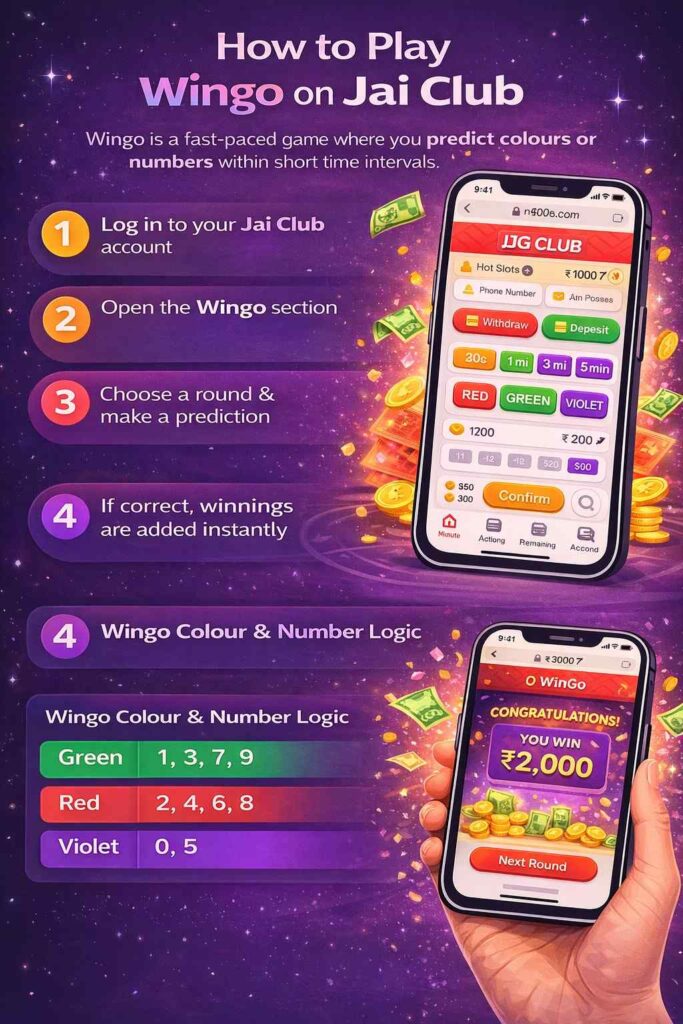
Big Small is the simplest selection in the number-draw games on Jai Club. Instead of naming the exact result, you say which half of the range it will fall in. That makes it easy to learn in one round, and also easy to play too fast, which is the real risk of the format.
The dividing line depends on the game, because each game draws a different kind of result. Check the definition in the rule panel of the game you have open before your first selection.
Making a Big or Small selection
- Open the Big Small format.
- Review how the platform defines each side.
- Check the countdown timer.
- Submit the selection within your planned amount.
- Read the result after the round closes.
Where the line falls in each game
- Wingo: one number from 0 to 9 is drawn. Small is 0 to 4 and Big is 5 to 9, five numbers on each side.
- K3: three dice are rolled and added, giving a total from 3 to 18. Small is conventionally a total of 3 to 10 and Big is 11 to 18.
- 5D: five digits are drawn. Big or Small can be chosen for a single position, where it works as in Wingo, or for the sum of all five digits, where the halves are set out in the game rules.
Why an even split is not an even game
With five numbers on each side, a Big or Small selection in Wingo wins half the time. Whether that is a fair deal depends on the multiplier in the rule panel: a selection that wins half the time needs to return exactly double to break even, and platforms normally keep a margin, either in the multiplier or as a service charge taken from each stake. Read the rule panel to see which applies. Over many rounds, that margin is what you pay to play.
Streaks, and what they do not tell you
Results come in runs. Six Bigs in a row will happen regularly in any long sequence of fair draws, and when it does, the next round is still an even split. Believing that Small is "due" is known as the gambler's fallacy. The trend chart under the game shows what has happened and nothing about what will. How often long runs turn up by chance is worked through in our piece on what a run of Big really means.
The same reasoning undoes the most popular system, doubling the stake after every loss. Starting from one unit, six losses in a row means the seventh stake is 64 units and 127 units are at risk in total, all to end up one unit ahead. A run of that length is not rare, and the stake limit or your balance is reached long before the system "works".
Keeping a simple format under control
- Fix the stake per round before you begin and keep it flat.
- Fix the number of rounds or the minutes, and stop when you reach it, whether you are up or down.
- Take one round off in every few. The countdown is designed to keep you in.
- Practise the rhythm first on the free Wingo demo, which includes Big and Small with play money.
- Read the full colour and number layout in the Wingo guide if you want to understand the other buttons on the screen.
Big Small checklist
- Simple rules do not remove risk.
- Keep sessions short.
- Do not chase sequences.
- Stop at your budget limit.
Players who read about Big Small rounds usually move on to reviewing past rounds, where results are posted and the full breakdown of one-minute Wingo results. Timers and history for each format live in the lottery lobby. The official Jai Club home is where every verified link begins.
Frequently Asked Questions
What numbers are Big and Small in Jai Club Wingo?
Small is 0, 1, 2, 3 and 4. Big is 5, 6, 7, 8 and 9.
What is Big and Small in K3?
K3 adds three dice. A total of 3 to 10 is conventionally Small and 11 to 18 is Big. Check the rule panel in the game for the definition in use.
Does Big come after a long run of Small?
No. Each round is independent, so a run of one side does not make the other side more likely.
Is doubling after a loss a safe Big Small strategy?
No. It does not change the odds, and stakes grow so quickly that a normal losing run can use up a balance or hit the stake limit.